Thought
Business
Why? and Why not?: the two questions that shape every project we run
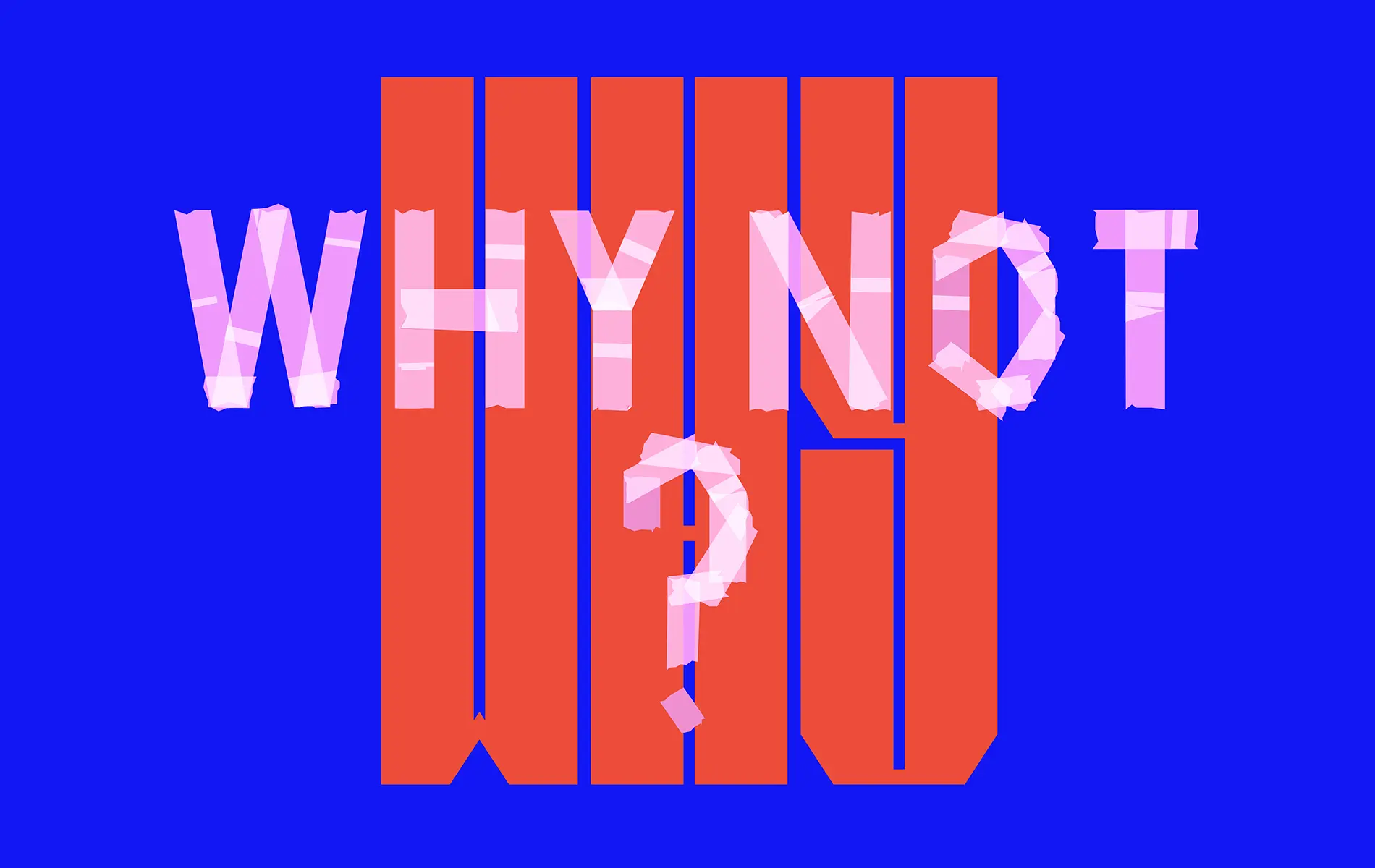
"Why?" grounds work in reasoning and produces defensible, industry-standard output. "Why not?" opens the possibility space and produces differentiated, sometimes contrarian output. Both are valid. Why? fits regulated industries, new brand presence, or defensive positioning. Why not? fits crowded categories, stagnated brands, or moments of disruption. Most projects benefit from using both in sequence.
Questions shape outcomes
In digital consulting work, the skill that gets talked about most is finding good answers. The skill that matters more, and gets talked about less, is asking good questions at the start.
Every project begins with a set of questions, spoken or unspoken, that shape what kind of work will get made. The questions define the problem space. The answers flow from how the problem is framed. Two teams working on the same brief, asking different starting questions, will produce very different work.
At SUFFIX we default to two starting questions on every project. "Why?" and "Why not?" Same brief, same information, very different outputs. Knowing which question to lead with, and when to bring in the other, is one of the quieter but more consequential skills in creative and strategic work.
This framework also sits upstream of something we've written about separately: the practice of presenting two design directions to clients (an Industry-Standard direction and a Differentiation direction). Those two directions are the tangible output of this thinking framework. Why? produces the Industry-Standard direction. Why not? produces the Differentiation direction.
Why?: grounded, defensible, standard
Starting a project with "Why?" means anchoring every decision in reasoning. Why is this audience right? Why does this channel fit the business? Why this visual approach rather than another? Every element has a justification, usually grounded in data, research, or category convention.
The output: work that's clear, defensible, and readable. It matches the category's best practices. Users recognize and understand it immediately. The team can articulate the reasoning behind any choice. Stakeholders can approve it without long debate because the logic is visible.
The upside: low risk, high clarity, easy to explain. The team is rarely wrong because each step follows from what's known to work. Onboarding new stakeholders is straightforward. The work passes review smoothly because the rationale is built in.
The downside: the output often looks similar to competitors in the same category. Every team in the category is working from the same research, the same user patterns, and the same platform conventions. Starting with "Why?" tends to converge on what most competent teams would produce with the same inputs. That can be exactly what a project needs, or it can be precisely the problem.
Why not?: possibility-driven, differentiated
Starting a project with "Why not?" means deliberately opening the possibility space. What could we try that nobody in this category has tried? What patterns from other industries might apply here? What would make this memorable rather than just correct?
The output: work that stands out. A contrarian take on what the category assumes. A mechanic borrowed from an adjacent industry. A position that stakes out new ground rather than optimizing the existing ground.
The upside: differentiation. In a crowded market, the work gets noticed. Audiences remember it because it's not what they expected. For brands that need to stand out, this is often the only path to attention.
The downside: the work is harder to benchmark. There's no direct precedent to compare against, which makes success metrics fuzzier and pre-launch confidence lower. Testing takes longer because the team is exploring new territory rather than refining a known pattern. The risk of getting it wrong is higher, and the failure mode is more public.
A worked example: one brief, two questions
Take a simple brief: a brand wants to increase email newsletter signups on their site.
Why? approach: The team researches email conversion best practices. Clear lead magnet (e.g., a free guide or template). Concise signup form (ideally inline on key pages). Prominent CTA above the fold. Social proof (subscriber count, testimonials). Follow-up welcome email with a clear next action. Every element is grounded in what consistently works across categories. The output will look like well-executed versions of what other brands are already doing.
Why not? approach: The team asks what hasn't been tried. Maybe the signup isn't a form at all, but a conversation with a chatbot that qualifies interest and collects email as the natural endpoint. Maybe the lead magnet isn't a generic guide but an interactive calculator specific to the brand's category. Maybe the subscription confirmation is a personalized piece of content rather than a generic welcome. The output will be less familiar, potentially more engaging, and potentially more confusing if executed badly.
Both approaches can work. The Why? version is the safer bet on average. The Why not? version has higher variance in both directions.
When to use Why?
Starting with Why? fits when:
- The project is creating the brand's first presence in a channel or category. Getting the basics right matters more than differentiating.
- The industry is regulated or high-stakes (healthcare, finance, legal). Deviating from conventions creates compliance risk.
- The audience has strong expectations about how things should work in this category. Breaking those expectations creates friction that outweighs any novelty benefit.
- The team is operating under tight constraints (time, budget, capacity) and needs to ship something defensible rather than exploratory.
- The brand is in a stable position and the goal is to execute, not to reposition.
When to use Why not?
Starting with Why not? fits when:
- The category is crowded and standard-looking work will be invisible. Differentiation is mandatory, not optional.
- The brand has been stagnating and needs to break a pattern. Doing more of what already isn't working won't help.
- The audience responds to novelty and expects surprise (fashion, entertainment, certain consumer tech).
- There's a moment of market disruption (technological, regulatory, or consumer-behavior shift) and the old playbook is becoming obsolete.
- The strategic need is specifically to differentiate, to reposition, or to enter new territory.
Failure modes of each question
Pure Why? produces conservative, defensible work that may blend into the category. The team does everything "right" and still gets ignored because the work is indistinguishable from the five competitors doing the same things equally well.
Pure Why not? produces novel work that may not be grounded in what the business actually needs. Differentiation for its own sake is a trap. Work that's memorable but doesn't serve the business problem is still failed work. The risk is spending budget on the novel idea without enough discipline about whether the novel idea is solving anything.
Most real failures we see come from applying one question rigidly without the other as a check.
Using both in sequence
The most reliable pattern we use: start with Why? to establish a defensible foundation, then apply Why not? to specific elements where differentiation would matter most.
In practice this looks like:
1. Establish the Why? baseline
What would a competent, category-appropriate version of this project look like? Research the standards, study the category leaders, map the conventions. This becomes the reference point.
2. Identify the differentiation points
Not every element of a project needs to be distinctive. Usually one or two high-leverage moments carry the brand's distinctiveness. On a website, it might be the hero concept and one or two key interactions. On a campaign, the core creative idea. On a product, a single mechanic.
3. Apply Why not? to those specific points
For the elements identified in step two, ask what's possible that hasn't been tried. Bring in patterns from adjacent categories, explore contrarian angles, push the brief.
4. Keep the rest grounded
Everything else stays in Why? territory. Functional, well-crafted, recognizable. The differentiation moments stand out more when the surrounding context is familiar.
This hybrid approach usually outperforms either extreme. Pure Why? risks invisibility. Pure Why not? risks unbounded experimentation. The sequence gives you a defensible foundation with strategic novelty layered on top.
Moments of disruption and the shift toward Why not?
Across the last several years, we've seen clients ask for Why not? more often than they used to. The reasons vary: pandemic-driven disruption changed what worked in marketing and digital products, AI capability shifts are reshaping what's possible in creative work, saturated ad platforms are pushing brands to rethink channels.
In each case the common factor is that sticking rigidly to the existing playbook (pure Why?) is producing diminishing returns. When the environment changes faster than the playbook updates, the playbook becomes a liability rather than an asset. Asking Why not? becomes not just creative ambition but strategic necessity.
This doesn't mean Why? has gotten less valuable. Reasoning from evidence still matters. What's changed is the ratio. In stable environments, Why? can carry most of the load. In fast-moving environments, the share of Why not? thinking has to grow, because the standards themselves are shifting.
The practical takeaway
The best teams we work with are comfortable holding both questions at once. They can defend their choices with evidence (Why?) and they can stretch into new territory when the brief calls for it (Why not?). Projects where only one question gets asked tend to produce either invisibility or unbounded ambition.
At the start of any new project, the question worth asking explicitly is: what's the right mix for this particular brief? Not as an abstract debate, but as a practical decision about where on the spectrum the team should be working. Once that's clear, execution gets sharper.
FAQ
When should a project start with "Why?" instead of "Why not?"
What kinds of projects benefit most from "Why not?" thinking?
How do I manage the risk of a "Why not?" approach?
Can both questions be used on the same project?
Writer
Director
Jate Saitthiti